
Music, movement, and Spanish — learned together, through play
Small groups for preschoolers. Enrollment isn't open yet — join the interest list to hear about dates, locations, and prices first.
Be the first to know
We're planning to start in Winter 2027 in Washington Heights, Inwood & Riverdale. Exact dates, locations, and prices will be announced soon. Join the interest list — there's no cost and no commitment.
Ages
3–5
Length
12 weeks, one 45-minute class per week
Group size
max. 6 children
Where
Washington Heights, Inwood & Riverdale — exact locations to be announced
Start
To be determined
Cost
To be announced. Families on the interest list hear first.
Groups are small, so families on the interest list will be contacted first when enrollment opens.
Listen. Move. Speak.
Every activity in the class follows the same simple path, so every child can take part — whether or not they already speak Spanish.
1
Listen
The class is bilingual — not every moment is in Spanish. Children hear music and instructions in Spanish, with English when it helps everyone follow along. In the important parts of each activity, we bring music, movement, and Spanish together.
2
Move
They answer with their bodies — jumping, freezing, speeding up, slowing down. Moving shows they understood, even before they say a word.
3
Speak
When they're ready, they add the words: singing, repeating, and even giving instructions to the group.
Music, movement, and language — in the same activity
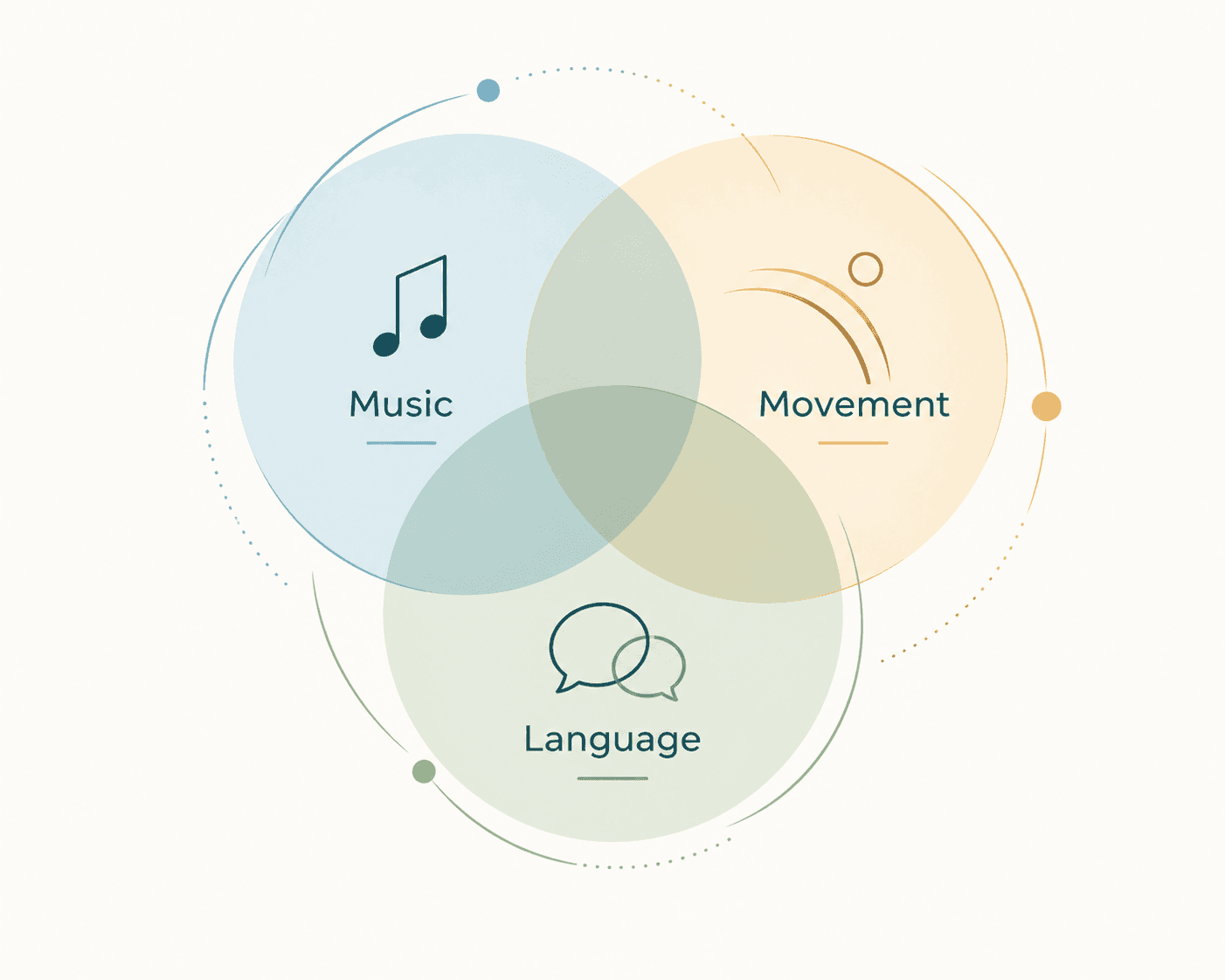
Music + Language
The rhythm of songs helps children hear the sounds and syllables of a language.
Movement + Language
Words are learned by doing them: salta, despacio, arriba.
Music + Movement
Following the beat, the tempo, and the pauses builds coordination and self-control.
All three
In our musical stories, each character has its own rhythm, its own movement, and its own words.
Music
Keeping a steady beat, responding to changes in tempo and volume, hearing high and low sounds, repeating short rhythm patterns.
Movement
Balance, coordination, galloping and hopping, stopping on a signal, and fine motor control with small instruments.
Language
Understanding and following instructions in Spanish, building vocabulary through actions and songs, and using simple phrases.
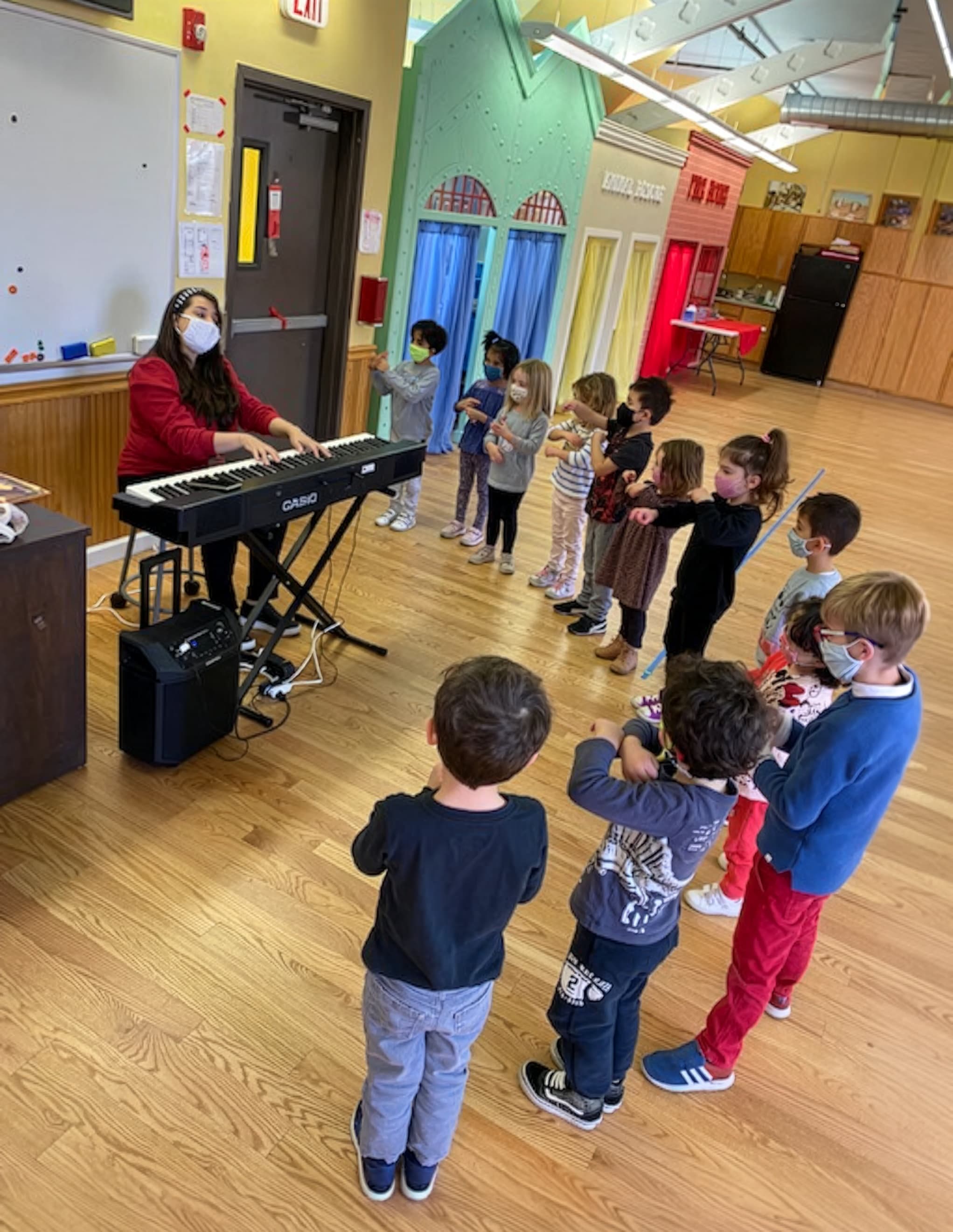
What you'll find in class
Each 45-minute class follows a familiar rhythm from week to week. The mix changes, but you'll see activities like these — examples, not a fixed checklist every time.
Welcome
For example, a greeting song and hellos in Spanish as everyone settles in.
Listening games
For example, walking, running, or freezing when the music or instructions change.
Rhythm, voice, and rhymes
Movement, singing, and playful language often happen together — for example, jumping to salta, singing along, or clapping the syllables of a Spanish word in the same song or game.
Finger play songs
For example, finger plays and songs for little hands — sometimes with small instruments woven in.
Musical story
For example, children invent movements and sounds for characters in a short musical story.
Calm down and goodbye
For example, slower music, a breath together, a goodbye song, and the phrase of the week.
Two starting points, one group
Spanish-speaking families
Many children in our neighborhood understand Spanish but answer more and more in English. Here, they're encouraged to use their Spanish out loud and often lead the games by calling out instructions to the group.
No Spanish at home
Children begin by showing they understand through movement — they jump when they hear salta and freeze on para. Words come at their own pace. The first goal is understanding and a positive feeling about the language.
The ideas behind the design
Rhythm and early reading
Preschoolers' ability to keep a beat has been linked to how their brains process speech sounds, one of the foundations of learning to read.
Movement and new words
Young children learning a new language remembered words better when they learned them through movements connected to their meaning.
Mavilidi et al., 2015, Educational Psychology Review
Music and self-control
Rhythm-based music activities, including stop-and-go games, have been linked to improvements in preschoolers' ability to hold back an impulse.
Frischen, Schwarzer & Degé, 2019, Frontiers in Integrative Neuroscience
These studies shaped how the classes are designed. Every child is different, and we don't promise specific results.
One class a week won't make a child fluent in Spanish.
What it can do: give children a joyful, regular experience of music and Spanish, build real musical skills, and support their physical development.
Most of the practice happens between classes
Every week
You'll receive the song, a Spanish phrase, and a short game to try at home.
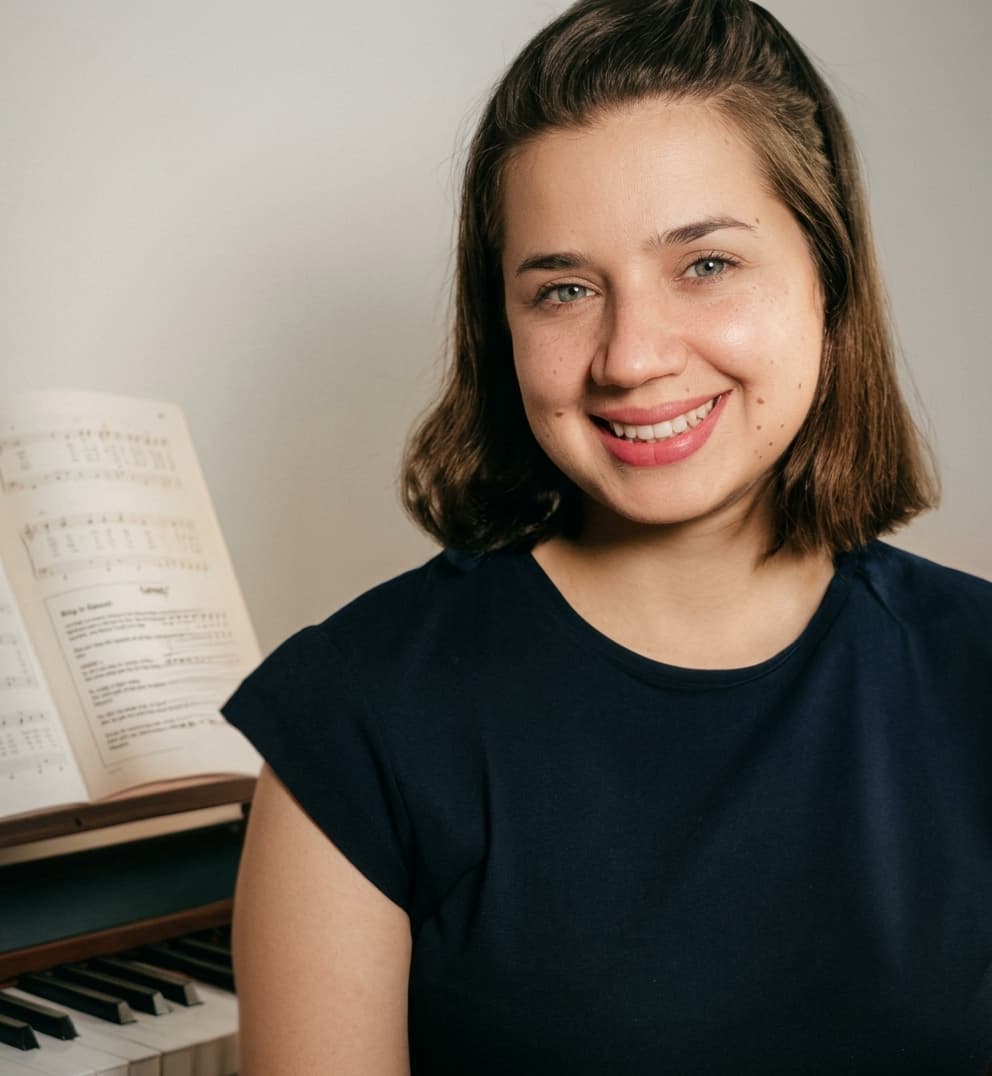
Claudia Govantes
Claudia Govantes is an award-winning vocalist, pianist, and music educator with over 20 years of experience bringing the joy of music to life. Based in New York City, her career spans performance, choral direction, and early childhood through middle school education across Cuba, Florida, New Jersey, and New York.
Claudia's artistic roots run deep. In Cuba, she served as Professor of Vocal Performance at the prestigious Amadeo Roldán Conservatory of Music, Professor of Music and Choral Conductor at the Havana Baptist Theological Seminary, and Associate Director of the Children's Choir at the Gran Teatro de la Habana.
Her passion for creative collaboration has led her to work alongside some of the world's most vibrant arts organizations. She served as Music Director for National Dance Institute (NDI) residency shows at the Catskill Mountain Foundation during the summers of 2022 and 2023, and continues to collaborate as an NDI teaching artist and pianist. She has also taught piano technique and music theory with Arturo O'Farrill Afro Latin Jazz Alliance (ALJA), served on the voice and piano faculty for the American Children's Orchestra for Peace, and provided music instruction and accompaniment for Bold Arts, All Saints Episcopal Day School, Ascension School, and Corlears School.
Whether conducting a choir, accompanying a dance residency, or guiding young learners through their very first musical steps, Claudia blends deep technical expertise with warmth, energy, and a passion for cultural expression.
Frequently asked questions
Does my child need to know Spanish or music?
No. Children join with no prior experience in either.
What if my child is shy?
Children can take part by moving first. Speaking comes at their own pace.
What about class format and policies?
Details like class format, age groups, and make-up classes will be shared with interest-list families before enrollment opens.
When does the program start?
We're planning to start in Winter 2027. Families on the interest list will receive exact dates first.
Where will classes take place?
In Washington Heights, Inwood & Riverdale. Exact locations will be announced soon. Tell us which area works best for you in the form.
Does joining the interest list commit me to anything?
No. It's free and there's no commitment. We'll simply contact you when enrollment opens.
What happens if the program launches?
We'll reach out by email with the enrollment offer and details. Because groups are small and interest may exceed available spots, some offers may include a limited time to accept a place.
Will you take photos or videos of my child?
As part of final enrollment, each family signs a release allowing photos and videos for the sole purpose of promoting Music, Movement & Language — for example, on our website and social media. Nothing is used outside that context. If you do not want your child photographed or filmed, please tell us when you submit the final application.
What will my child be able to do after 12 weeks?
Most children will follow instructions in Spanish through movement, keep a steady beat, and join in the songs and games. Progress looks different for every child.
My child is 5 or older. What can they do?
Govantes Music Academy offers 1-on-1 lessons for children 5 and up. Govantes Music Academy
Groups are small, so families on the interest list will be contacted first when enrollment opens.
Join the interest list